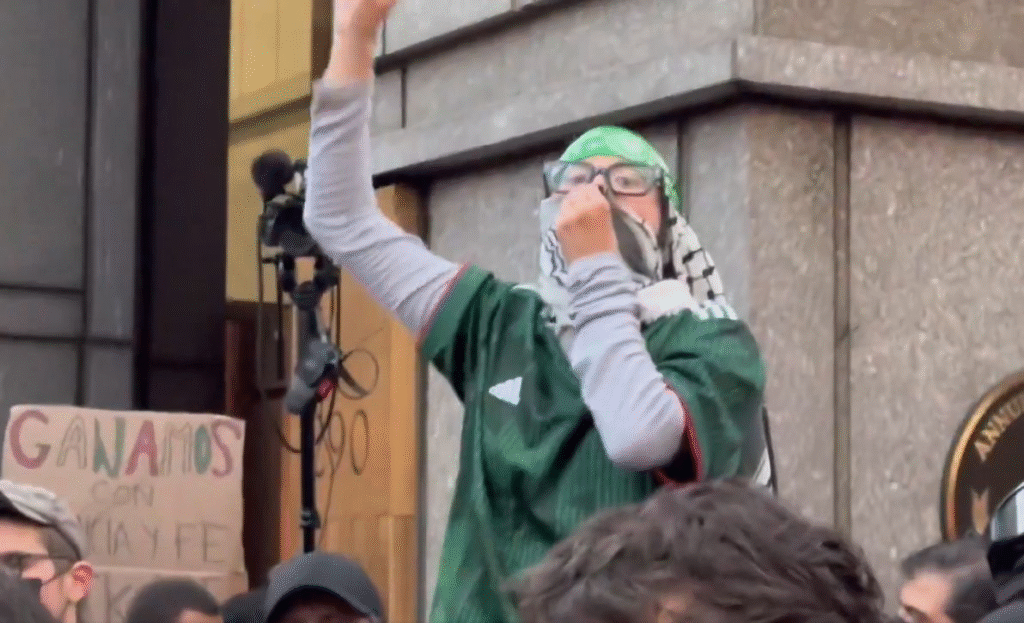
Tonight in Manhattan
During a protest outside the immigration courts at Foley Square in New York City, a demonstrator wearing a HAMAS headband led radical chants, repeating the phrase “Globalize the Intifada.” The video, captured by journalist @elaadeliahu, has sparked concern due to its ideological extremism.
The chant — used in several demonstrations since 2023 — seeks to extend the violent logic of the Palestinian intifada beyond the Middle East, encouraging global resistance against governments and institutions labeled as «oppressors,» such as ICE in the United States.
HAMAS and the Muslim Brotherhood: Historical Links and Global Strategy
1. Shared Ideological Roots: HAMAS was founded in 1987 during the First Intifada as the Palestinian branch of the Muslim Brotherhood. Its 1988 charter promotes the establishment of an Islamic state governed by sharia law through jihad.
2. Organizational Connection: The Muslim Brotherhood provided HAMAS with its religious and social infrastructure—mosques, schools, and charities—which enabled its growth in Gaza and the West Bank. HAMAS founder Sheikh Ahmed Yassin was an active Brotherhood member.
3. Common Goals: Both groups deny the legitimacy of the State of Israel and advocate for its elimination through a religious-political struggle. Their broader worldview includes strong anti-Western and anti-Zionist stances.
4. International Financing: The 2008 Holy Land Foundation trial revealed how over $12 million was funneled from the U.S. to HAMAS under the guise of humanitarian aid. Five foundation leaders were convicted of funding terrorism.
5. Political Influence: The Muslim Brotherhood briefly rose to power in Egypt in 2012 with the presidency of Mohamed Morsi, boosting HAMAS’s legitimacy and cross-border support—support that declined after Morsi’s ouster in 2013.
6. Global Presence: Brotherhood-linked organizations continue to operate in the West, including in the U.S., often with 501(c)(3) tax-exempt status. Though direct ties to HAMAS are denied, court cases have documented indirect connections.
Why It Matters
The chant “Globalize the Intifada” surfacing in U.S.-based protests highlights how extremist ideologies can infiltrate left-wing social movements—especially those focused on immigration or civil rights. The visible presence of HAMAS symbols on U.S. soil signals potential threats of radicalization and ideological propaganda.
The incident has reignited debate in Washington about designating the Muslim Brotherhood as a Foreign Terrorist Organization (FTO)—a move previously supported by figures like Donald Trump, JD Vance, Marco Rubio, Pete Hegseth, Seb Gorka, and others.
While HAMAS has been officially designated as a terrorist organization by the U.S. since 1995, the Muslim Brotherhood has not, despite repeated legislative efforts.
What’s Next
The U.S. Congress may revisit proposals to label the Muslim Brotherhood as a terrorist entity, which would result in financial sanctions, travel bans, and restrictions on affiliated groups. Domestically, there’s growing pressure to investigate nonprofit organizations that promote extremist agendas under the cover of civil rights advocacy or humanitarian work.
Sources and Links
- https://nypost.com/2025/06/10/us-news/at-least-15-arrested-in-nyc-anti-ice-protest-as-thousands-take-to-the-street
- https://www.state.gov/foreign-terrorist-organizations/
- https://www.justice.gov/archive/opa/pr/2008/November/08-nsd-1019.html
- https://www.congress.gov/bill/115th-congress/senate-bill/68
- https://www.reuters.com/article/us-egypt-brotherhood-idUSBRE96K0MO20130721
- https://www.brookings.edu/articles/understanding-hamas/
- https://www.adl.org/resources/backgrounder/anti-israel-activists-globalize-intifada-campaign
- https://www.washingtoninstitute.org/policy-analysis/hamas-and-muslim-brotherhood